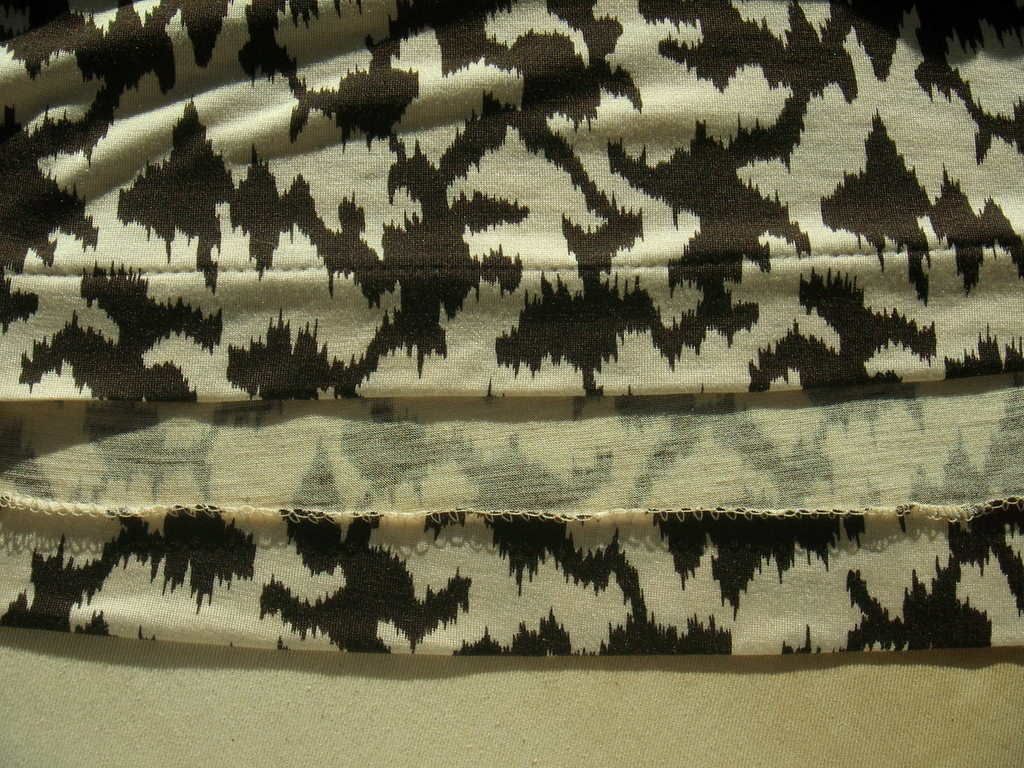
Monday, May 16, 2011

Karina Grimaldi maxi dress knockoff

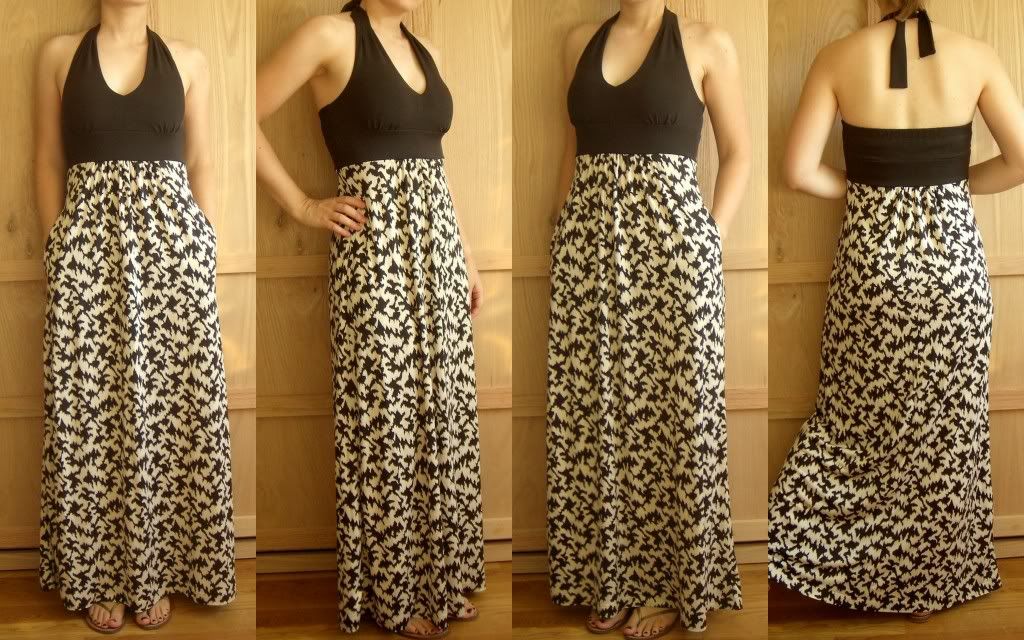
I've been drooling over this Karina Grimaldi maxi dress on shopbop for awhile now, and finally decided to do something about it over the weekend.   Here is the description from shopbop.com's website.
This scoop-neck jersey maxi dress features a racer back and a striped skirt. Unfinished hem. 1.5" straps.

* 56" long, measured from shoulder.
* Fabrication: Jersey.
* 100% modal.
* Hand wash or dry clean.
* Made in the USA.


I started with my favorite tank top pattern, and changed the back to more of a racerback style.  I lowered the neckline as well.  For the skirt part I cut wide crosswise strips, then serged them together to make panels for the front and back.  The only tricky part was figuring out how wide to make them, I really liked the proportions on the model but seeing as I'm not 5'10" I wasn't sure it would work.  I tried to guess how long the skirt portion would be, divided that by 5, and came up with 7.2" based on my height.  I cut the strips 8" wide (including seam allowances), making them wider at the bottom.  I measured another maxi dress of mine to see how wide the bottom needed to be (~35"), and just made the strips narrower as I went up until it matched my hip measurement.   Once I had the front and back skirt panels, I pinned them together and serged straight a-line side seams, cutting off all the excess.  Even with good planning, I still had to make adjustments as I went along so it would hang parallel to the floor, pinning it to the tank top until I liked how it looked.
8" wide strips serged together
 I used 11oz rayon/lycra jersey from Emma One Sock.  Whenever I need a good quality knit I head straight for Linda's website.  I know her fabrics are always excellent quality and when I spend the time to sew something I don't want to run into pilly knits or poor recovery.  Not to mention the time saved not having to look all over the place for the right fabric.  I got a yard of the almond and 1.5 yards of the black, and had enough leftover for probably a tank top from each.  ~$50 in fabric, versus $196 for the RTW dress.  In addition I added a power mesh lining to the top part of the skirt, the 11oz weight isn't see through but in a light color it needs something.

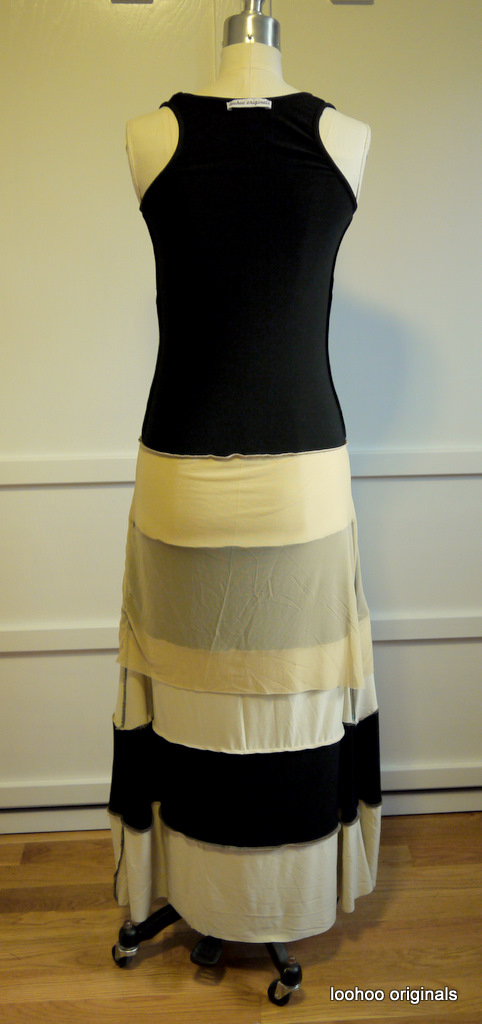


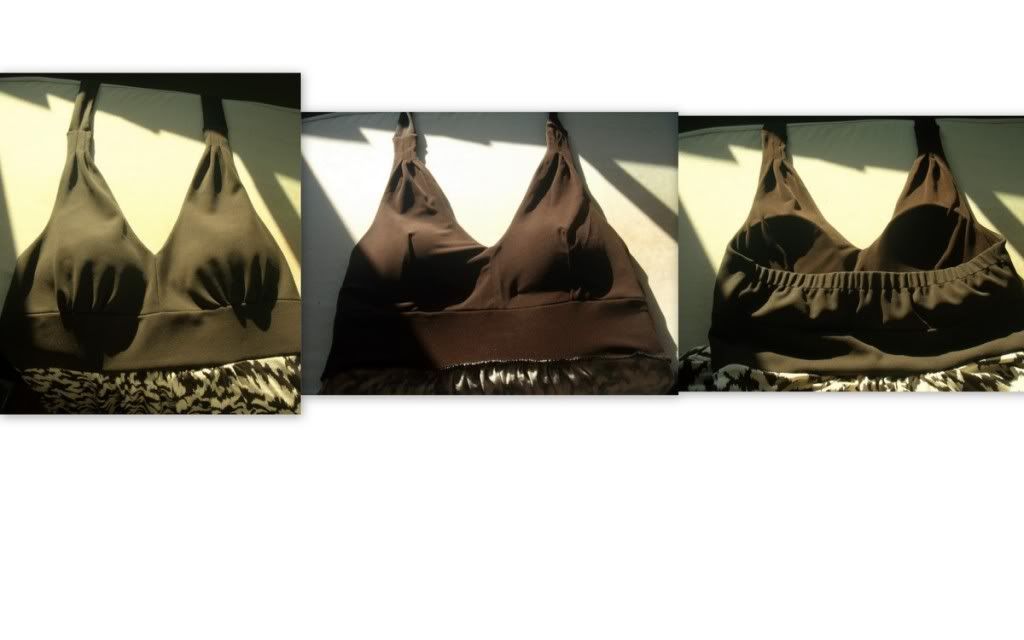
Inside out: power mesh half lining

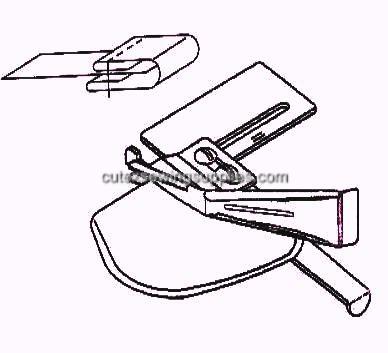
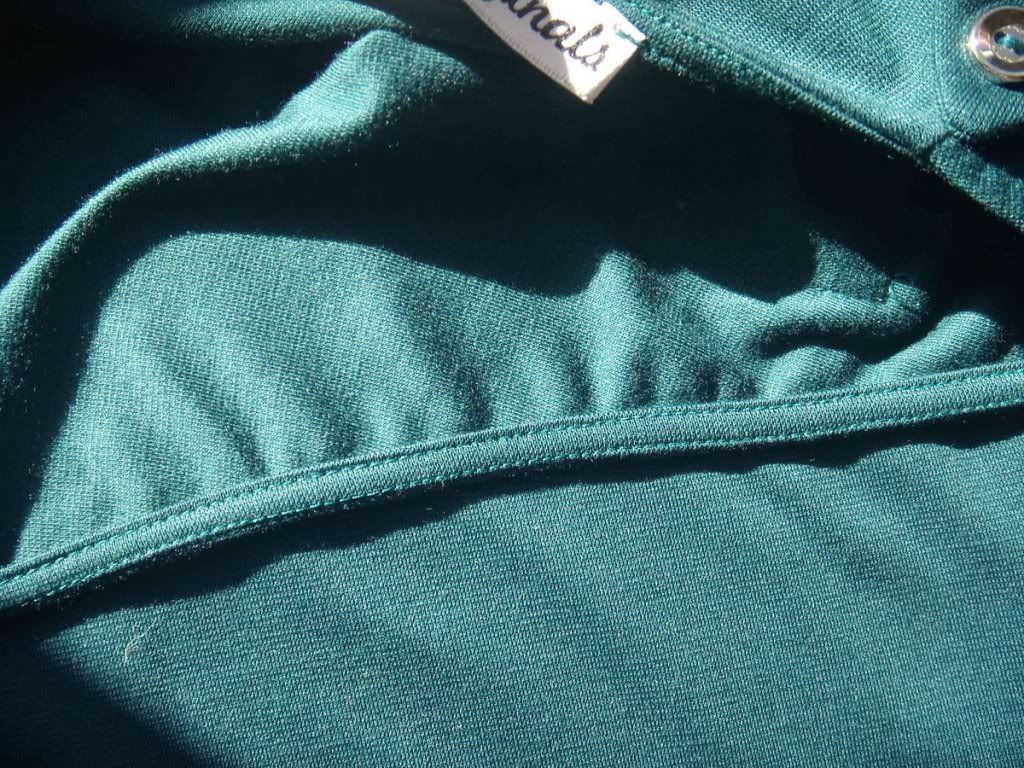
I did my usual neckline/armhole finishing using my right angle binder, I took some photos right after binding this time so you can see what it looks like before being turning to the inside and topstitched.  Depending on how much the strips get stretched when applying the binding, the fabric may look pretty puckered, but it usually turns out okay once it's on the body.  I always do a test run to see if the fabric will behave in the binder, some fabrics are just too thick or stretchy for it.


Top:  after binding  Bottom:  after topstitching binding to inside


 This is what the top of the dress looks like laying down, not too hot, right?  But when worn everything stretches out flat and those openings are nice and stable.


I spent about 8 hrs total on this, which would have been way faster with a full pattern but I do like the flexibility of the tweaking process.   Having a dressform to work on is a huge help when trying to picture proportions and lengths. 


Posted by Picasa

Monday, May 9, 2011

Yes I am a silk snob

I tried on this henley tank in Target the other day and loved the shape, but not the fabric.  It was polyester and already clinging to me in the dressing room.  Fortunately I've got a nice stash of silk prints, including this Cynthia Steffe print from Emma One Sock a few years ago.

I used some old poly to drape the shape on my dressform, cutting and pinning until I was happy with the neckline, armholes, and width.  Then I took it apart, traced the pieces onto butcher paper with my tracing wheel, and balanced the pattern so both sides would match.  I added seam and hem allowances and the pattern was ready to go.


I used my favorite neckline/armhole binding technique, applied with my industrial right angle double-fold clean finish binder, then turned to the inside and topstitched.  I chose not to staystitch the armholes, but ended up handling the fabric more than I usually do so I got some stretching in that area.  It's not horrible but usually this binding technique lies perfectly flat or even hugs the body, and it's standing away a bit in the armholes.   Lesson #1:  Always stabilize bias areas shortly after cutting to preserve the shape.

I used this method to make the neckline placket, I had used it before on the sleeves of one of DH's shirts and found it simple.  Not quite as accurate as I'd like, and I had issues with the dimensions given for the strip.  (I used a 2 inch strip to begin with).  One of these days I need to try two-piece plackets.  Also, I only used interfacing on 1/2 the strip, I was worried about making the placket too stiff in this lightweight silk.  However this wasn't enough stabilization, the buttonholes distorted the strip a bit.  I used the lightest weight interfacing I had, and it probably would have been fine interfacing the whole strip.  Lesson #2:  Always stabilize openings.


I used an industrial wire hemmer attachment to turn the 3/16" hem, I haven't perfected my technique with it yet but it's passable and so much faster than any other method that I just keep trying to do better each time.   

  Even with the issues listed, I still love the tank and will get a lot of use out of it this summer.  It's a great shape and length to go with skinny pants and jeans.

Here is the construction order (all done on Juki industrial straight stitch):
  1. French seam one shoulder seam.
  2. Bind sewn armhole and neckline. (right angle binder)
  3. French seam other shoulder seam. (on Janome machine to avoid taking binder off Juki)
  4. Bind other armhole
  5. French seam side seams.
  6. Hem (3/6" wire hemmer)
  7. Turn in and press neckline/armhole binding, topstitch.
  8. Mark and cut slit for placket
  9. Sew placket strip to opening, press into shape and topstich.
  10. Buttonholes (Janome)
  11. Buttons (Janome)

Tuesday, March 9, 2010

Leather Wrap Belt

I have been sewing on and off, but as you can see I haven't been blogging about it.  This is one of my more recent projects, after seeing this belt in a boutique on vacation I was inspired to go home and recreate it.  They wanted ~$200 for it in store, and I immediately thought of this piece of red leather I stashed at the PR weekend in LA that was sitting on my fabric shelf.

I'm not going to post any kind of tutorial, it's a small designer and if you're interested in purchasing one you can read about the company here.  There's not a lot of pictures online either, I did this mostly from memory since I didn't take pictures in the store.  If you have a chance to check one out instore, do it!  It's a great design, although not something I've never seen before.  It's easy enough to figure out.  There are velcro closures on the inside so it's continuously adjustable through about 5 inches of waist measurement.  

This was my first time sewing leather, and honestly it was a breeze on my industrial.  This is a lighter weight leather (lambskin I think) and it handled it just fine.  I broke one 90 needle when sewing through the velcro, but the rest was easy, and I sewed the lining to the leather with a sz 70 needle.  They make special leather point needles, but the regular/sharp point worked just fine. 

Thursday, September 17, 2009

Iterations and binding techniques

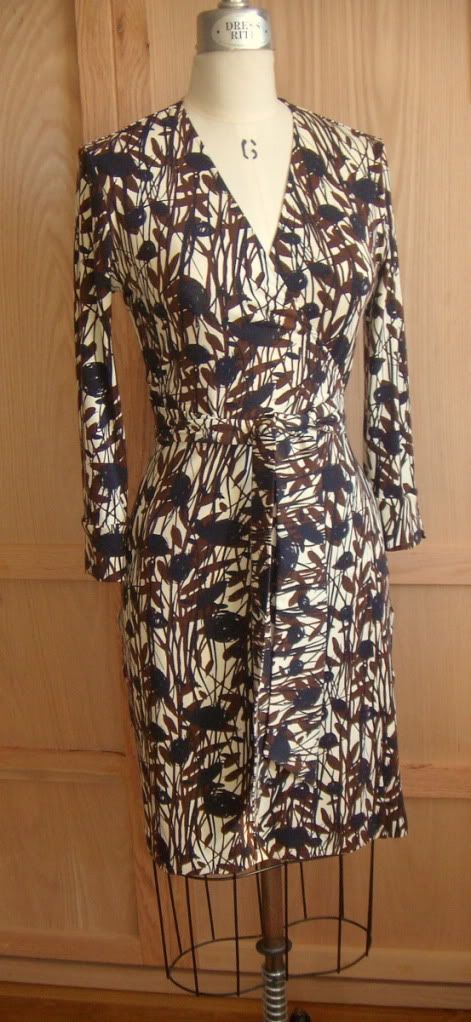
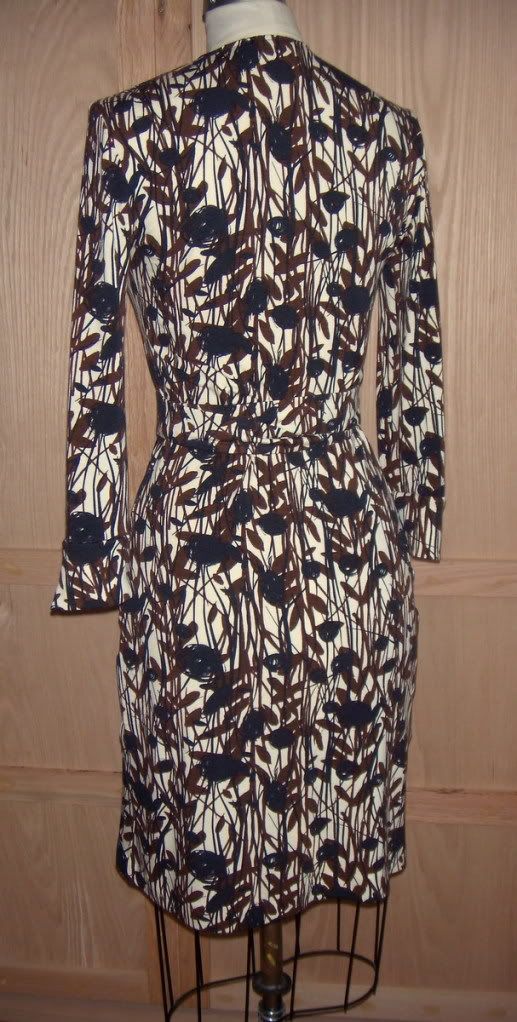
I made another DVF Julian a few weeks ago and already wore it to work, I was making this pattern for a friend of mine and while I had it out decided to cut one for myself. This fabric is a rayon/lycra print from Emma One Sock, my favorite fabric dealer, er, I mean supplier. :-)

Rayon/lycra 'leafy stalks' print in blue, black, and brown on cream


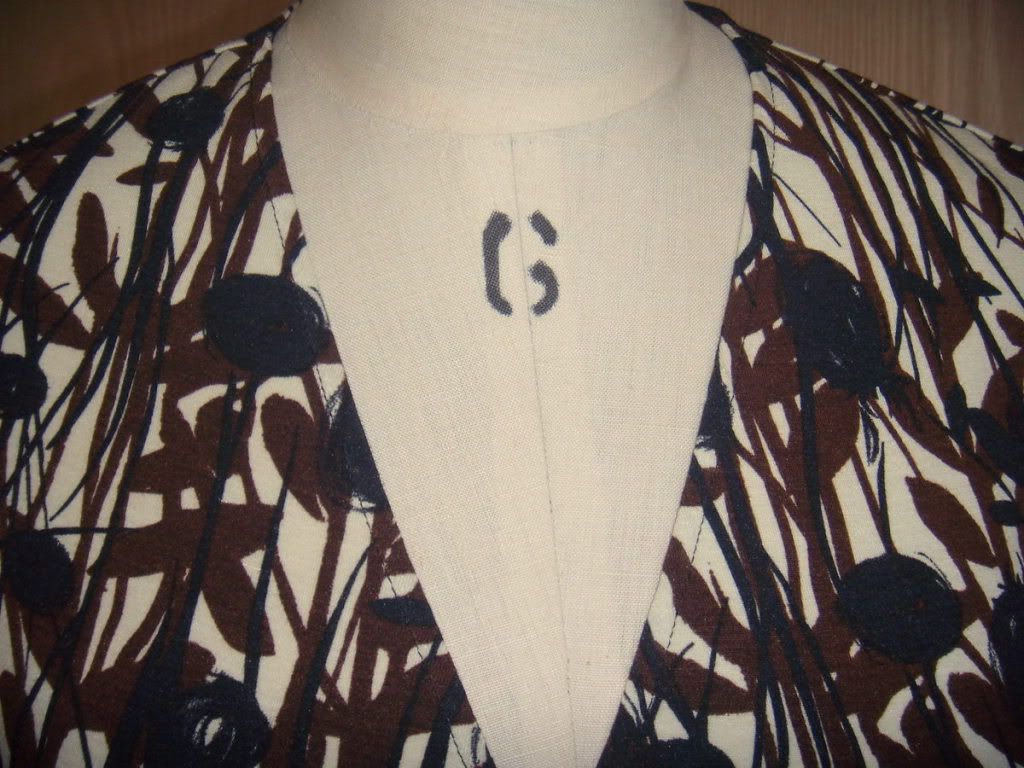
For this fabric I chose to finish the edges by serging 1/4" clear elastic to the neckline and front edges in one pass, then turning to the inside and topstitching. I use a special elasticator foot for my serger, which helps guide the elastic exactly on the seamline and has a tension screw to set how much I want the elastic stretched while it's being serged. Around the neckline I want enough stretch so the fabric puckers a bit when laying flat, when worn wrapped and tied it flattens out and prevents any gaping. When I get to the front edges of the skirt, I undo the tension on the elastic so it doesn't pucker.


The serged elastic provides a nice edge for turning under, it's super easy to get a 1/4" fold.


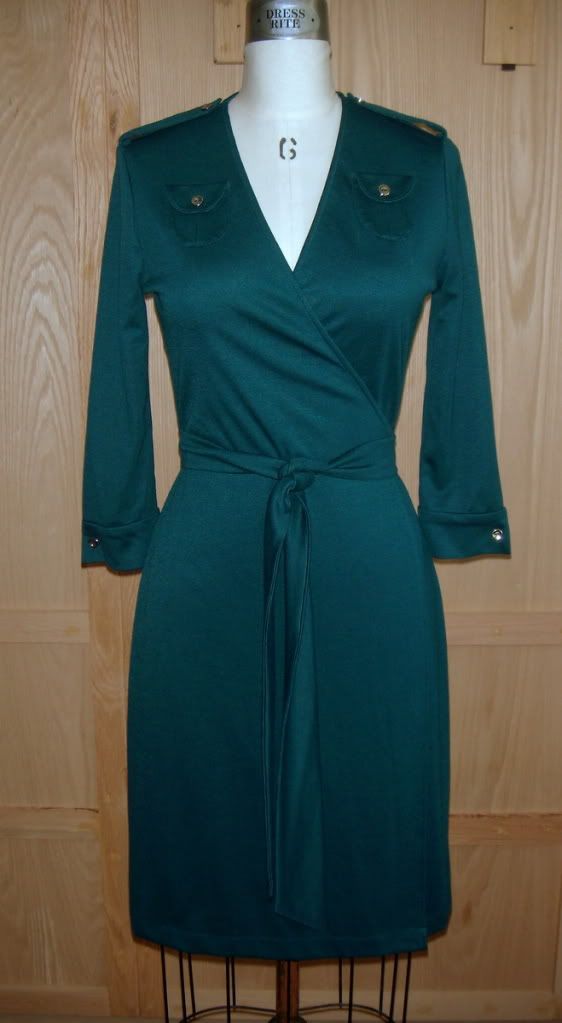
The dress I made for my friend is the same pattern, but I added some fun details: fake pockets, shoulder tabs, and buttons. Look familiar? She liked it so much I found some poly/rayon/lycra doubleknit that would look similar to the wool. She chose silver-tone metal buttons for hers.


For this fabric, I chose to use double fold binding, as far as I can tell it's exactly what DVF uses to finish the edges of her dresses. It's the same thing as bias binding, except it's done with a clean finish double fold binder for an industrial machine, and you don't preform the fabric. The binder I have takes a 1" strip of fabric, and forms a 1/4" binding. It's designed for light-medium weight fabrics, so when this doubleknit passes through it stretches it a bit, which accomplishes the same thing as stretching the elastic. I use crossgrain strips of fabric, and on the first pass bind the raw edge. Then I turn the whole thing, so the binding is completely on the inside, and topstitch. This edge is very stable and durable.

Industrial binder, it wraps a strip of fabric around a raw edge, making a clean finish.


Lying flat, the front also looks slightly puckered, which is a good thing.


This binding also provides a nice edge for turning under, and I usually topstitch from the inside to make sure I'm catching the binding. Make sure your stitch looks nice from the wrong side though, you may have to loosen up the top tension to be sure the thread is pulled into the fabric.

Wednesday, September 16, 2009

Simplicity maxi dress

I'm still trying to get caught up with recent projects, this last weekend was quite productive so I'm starting there. :-) I've been wanting a maxi dress for at least 2 years now but never got around to buying/making one. After seeing Cidell's version of this Simplicity pattern (3503) I knew I had to make it up. I recently cleaned and reorganized my sewing room (need to take some pics of that too!) and went through all my fabric, and found a small piece of brown silk jersey, and a larger cut of a DVF brown/cream silk jersey print I bought at Britex in San Francisco with my sister that would be perfect for it.


I made the halter neck, long version, mostly in a size 8 but I had to make a lot of adjustments. I made a muslin first, and from that made the following:

-Narrowed the top back piece by 1/2" on each side (making it less than a size 6!)
-Narrowed the back band by the same amount
-Removed 3/4" from the bottom of the top back piece at the CB, tapering to nothing at the side seams
-Removed 1/2" from the back skirt at each side seam
-Narrowed the neckline and armholes by 1/8" on the lining pieces
-Added a top back lining, used wider elastic in the back and sewed a seam between the fabric and lining for a casing
-Raised the pockets by 1" (they were oddly low)
-Added bra cups inside the lining
-Darted the lining instead of gathering like the outer fabric
-Interfaced all the solid top pieces of brown silk jersey with pro-sheer elegance from Sew Exciting

I wasn't planning on fully interfacing the top, but after fusing a test piece I was loving the way it looked. It just made it look expensive. LOL

I made some changes to the construction order, in general I sewed all the front pieces together, then all the back pieces, and finally joined them at the side seams. This made it easier to adjust the side seams in one go if I needed to. Once I was happy with the top, I serged the skirt on following the instructions. I understitched the lining around the neckline and armholes to keep it from peeking out.


I didn't have enough brown silk jersey to do a self lining, and I also didn't have any thin foam bra cups in my stash. I solved both these problems by buying a clearance dress at Ross for $11, it was made of a decent quality poly and had bra cups in it. I cut it apart, and got almost a couple yards of fabric from the skirt, and some great bra cups. Sometimes the fabric store is not the only place to get supplies!

And finally, I have to thank DH for pinning the hem for me. I was having a hard time getting it just above the floor, so I talked him into helping me. I had to stand there for close to a half an hour, but boy is it even! He did a good job. :-) I did my usual not-so-blind hem finish on the serger.

Tuesday, September 15, 2009

Can you handle another Simplicity cardiwrap?

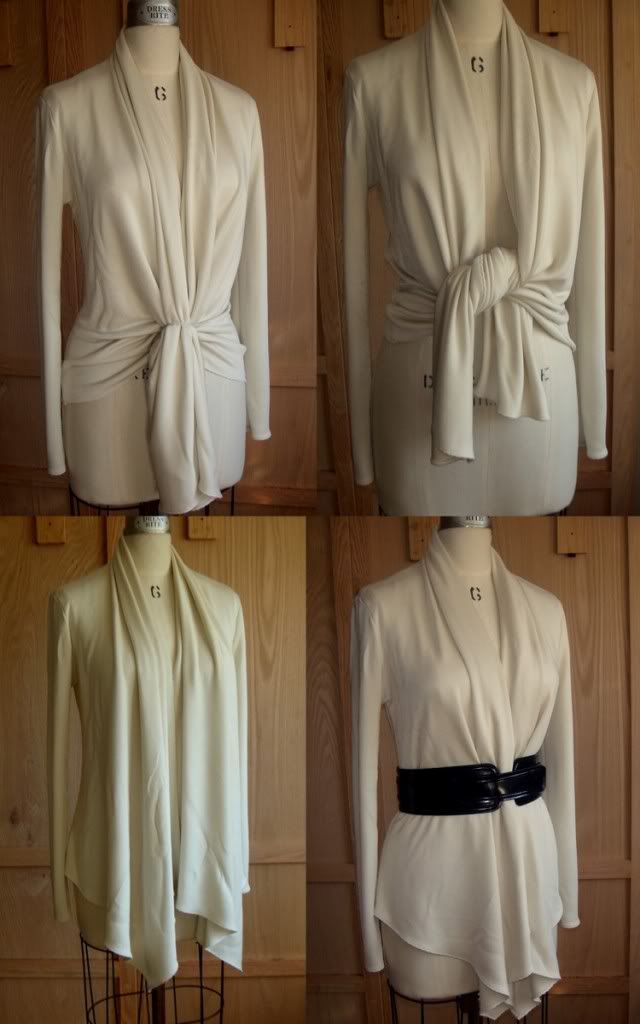
Jumping on the bandwagon, I decided to make a cardiwrap from some Carolina Herrera heavyweight viscose sweater knit I got from Emma One Sock. I bought this fabric back in February, with some type of wrap in mind so after seeing all the great versions lately (love Christina's!) I decided it was time to cut into it. This fabric is super drapey, medium-heavyweight, with a distinct knit stitch to it, and a nice sheen to the ivory color. I made a muslin from some thin rayon jersey first, and decided it would work with the weight of this fabric. What I didn't think about was the slippery-ness of it! It is so fluid and smooth when I throw it over my shoulder it falls right off. LOL Fortunately it will hold a knot, so I can tie it in the front or tie the two corners together and put it behind my neck (forgot to take a pic of that one). But my favorites for this fabric are definitely loose as is and with a belt.


I think this pattern (Simplicity 2603) is great for the overall stylelines, the shape of the front pieces and the gathered neckline are fantastic. However when I was comparing the sleeve and armhole shapes to my TNT self drafted patterns for my knit wrap dresses, the Simplicity pieces were terrible. The sleeve cap was way too short and had way too much ease. I prefer a higher cap with stable knits, I think it lays better. I used a size XS here because, surprise, Simplicity had an inch or so of ease in the bust for a KNIT pattern. I usually use negative ease for knits, and I wanted it to fit snugly, so I sized down. I completely scrapped their sleeve pattern, and traced my own armhole onto the Simplicity pieces. I had to add to the back neckline seam to get all the seamlines to match up, but the shoulder seams were already pretty close to the right length so it wasn't too hard. I also made a full-length sleeve, it hangs to about the top of my thumb. It's so much easier to take pics on the dressform, but my shoulders are actually a tad wider and it looks better with the arm filled out. This is view C, the shorter length front.


I had a hard time trying to figure out how to finish the raw edges, most people have been making this from jerseys that can be left raw as they don't fray. This fabric doesn't necessarily fray, but it does get a bit fuzzy looking, especially after being tied and stretched. I experimented with a bunch of finishes, including several on my serger. All of them were giving me a lettuce edge effect which I didn't want for this. Finally I tried a shell stitch on my sewing machine, and it looked great and had the elasticity and recovery I needed. I was practicing on scraps first, and was a little worried that it would look old-fashioned on the actual garment, but I just love how it looks.


I think it adds something very special to an amazing fabric and a great style. It was easy to do as well, I used my blind hem foot to help me turn under an accurate 1/4" of fabric as I went, no pressing involved. I did all the edges before putting it together, I would definitely recommend this as it's much easier to do before you construct the neckline. The hems can be done after you serge the side seams. I also set the sleeves in flat, and stitched in the ditch at the neckline to secure the neck piece and cover the elastic.


Oh and want a tip for using a decorative stitch, or any stitch really, on a hem? Before you try to stitch over those side seams, trim off a little bit of the seam allowance, fold it under and press with your iron, then take a hammer and pound it flat. Yes a hammer. I believe they sell 'sewing hammers' made of plastic, but I use a regular old hammer and it works just fine. You want to get the bulky side seam as flat as possible to make it easier for your machine to pass over the area, and believe me a hammer does a much better job than your iron. Try it. But watch your fingers. Not that I've ever whacked mine while trying to hold the fabric in place. :-) I forget where I heard this tip, but it was probably at Fashion Incubator. Thanks Kathleen.

Tuesday, August 25, 2009

A dress form and much-needed tank tops

I'm super excited about my latest craiglist acquisition, a Dress Rite professional dress form. I just picked her up last Thursday, for a great price and in almost new condition. She has collapsible shoulders, linen covering, thick padding, and is on a sturdy wheeled frame with fully adjustable height. I've had so much fun playing with her this weekend, draping fabric is a breeze on a form, and combining outfits is so much easier. It gives you a very objective look at whatever you are working on. She's a little smaller than me in the waist and hip, so I'll probably try a bit of padding if I want to use it strictly for my own garments. The shoulders and bust are actually really close, it was weird to see my own clothes on her! No name yet, but I am up for suggestions from the blog world. :-)


I've been trying to replace worn items in my closet, and of the 5 favorite tanks I have 3 of them have holes. I made a copy of the pattern (from RTW), which was super easy as its the same thing front and back. Of course the fit isn't 'perfect', but as long as you use a stretch knit it's fine. And the added benefit is you can craft two different necklines, and just wear it whichever way you are feeling that day. I like to make a higher and a lower one on the same top.

The first one I made is from a black bamboo rayon/lycra from Stonemountain Fabrics in Berkeley. I was inspired by this tank from J.Crew and decided to make my own. I cut 5/8" strips of fabric, gathered them using elastic thread in the bobbin, and sewed them to the tank spaced 1" apart. Knits don't fray so you don't have to finish them any other way. Then I bound the neckline and armholes using more strips (1 1/4"), sewing them right sides together while stretching the strip a bit, folding the strip to the inside, and topstitching from the right side catching the raw edge of the strip. I trimmed away the excess strip on the inside. This isn't my favorite way of doing binding but it works. I did all this on my home machine.

And I made another top from this same pattern, from some silk jersey I purchased in Portland at PR weekend. For this one I did the binding differently, this is my preferred method and the one I use on my wrap dresses. I use an industrial double fold binder that takes a 1" strip of fabric and creates a 1/4" binding along the edge. Then I turn the whole thing inside and topstitch. This was all done on my industrial machine. I really need to get around to doing a tutorial on this method. Maybe this weekend. :-)
For hemming knits lately I've been super lazy and using my blind stitch foot on my serger. It's incredibly quick, and if you're not too picky about how invisible it is you don't have to mess with adjusting the foot to get it perfect. I have it set for doing thicker doubleknits, and on these thinner ones the thread is visible from the right side, but it's even and looks better than a topstitched hem.